The whole operation on one screen, finally
Staff, stock, customers, orders and vehicles in a single system — with a manager view that shows what is actually happening right now, and field apps that work in a warehouse with no signal.
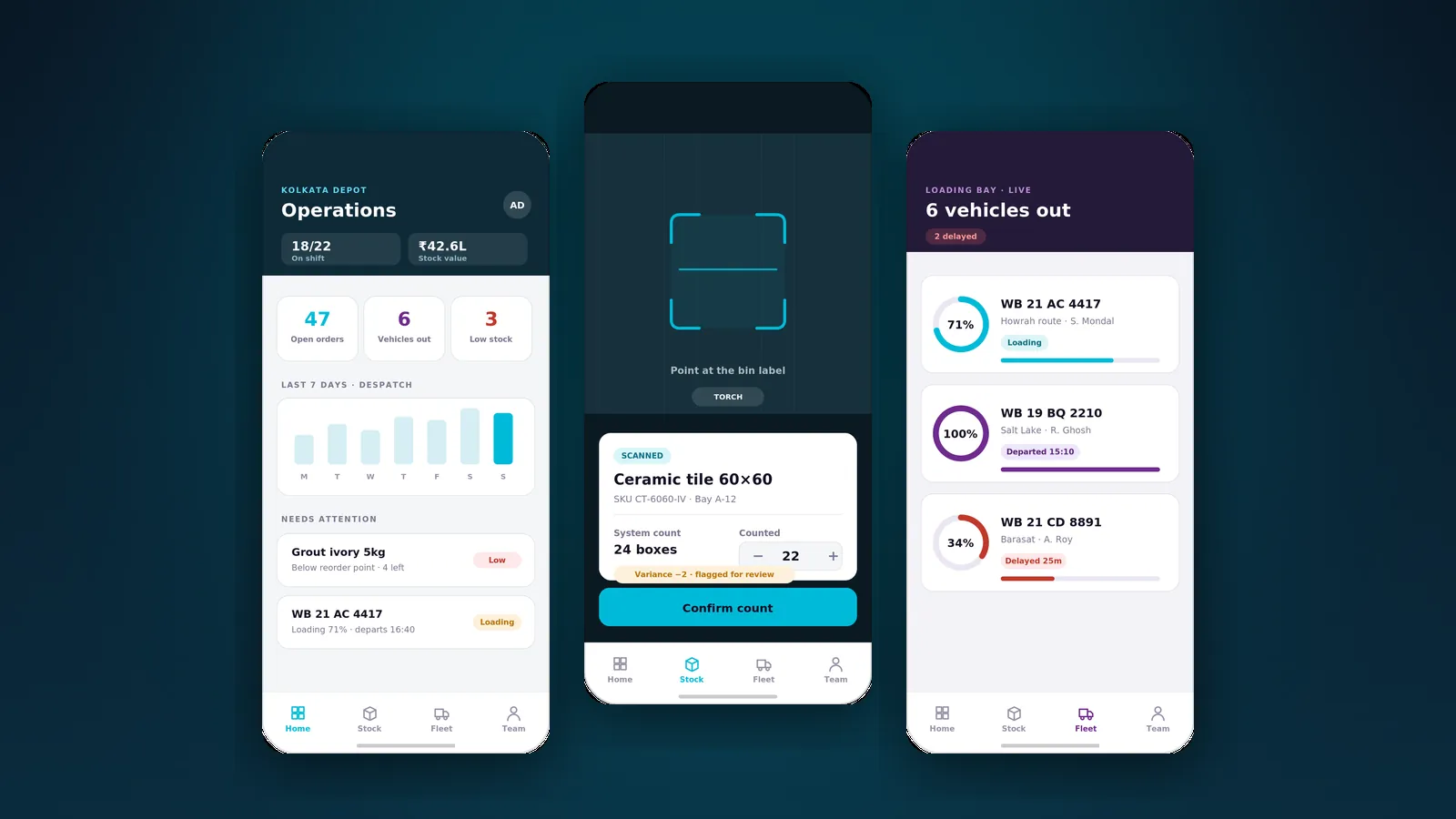
Most businesses do not lack data. They lack it <em>in one place, at the moment someone has to decide something</em>.
What each person actually sees
Different people need different things from the same system. Each role gets a screen built for the job in front of them, not a cut-down version of someone else's.
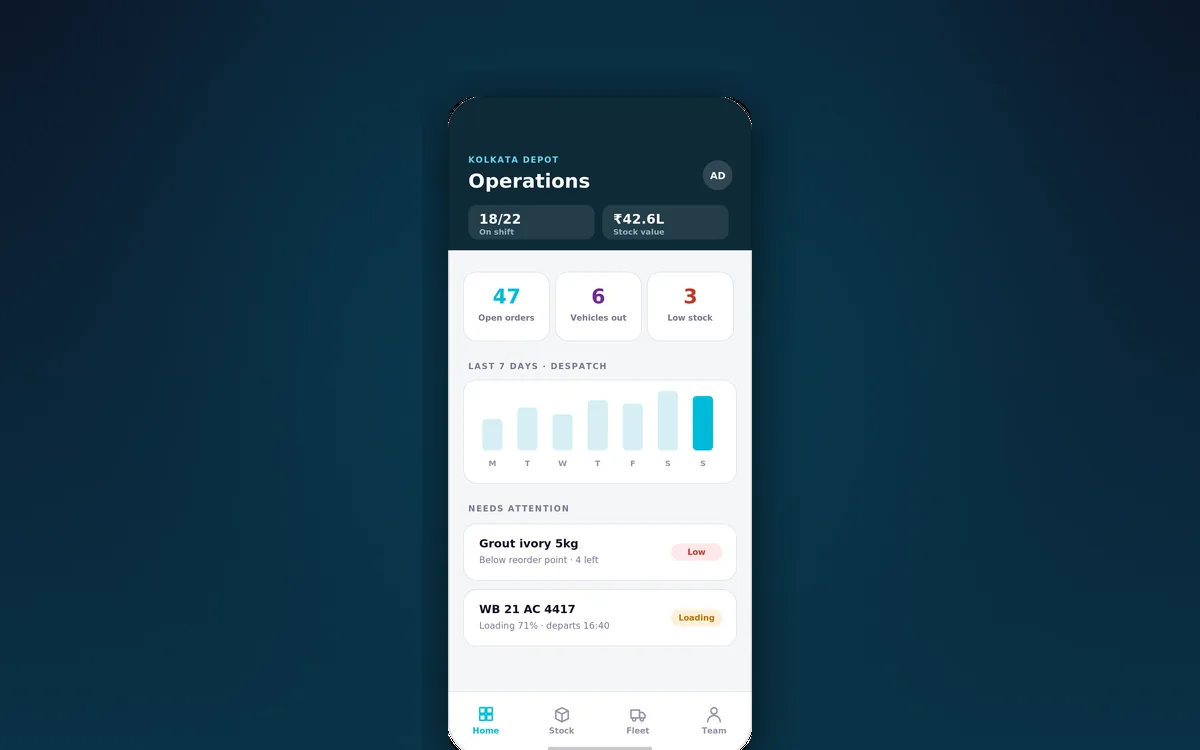
Today, at a glance
Who is on shift, what stock is worth, how many orders are open, which vehicles are out, and what needs attention before it becomes a problem. One screen, refreshed live.
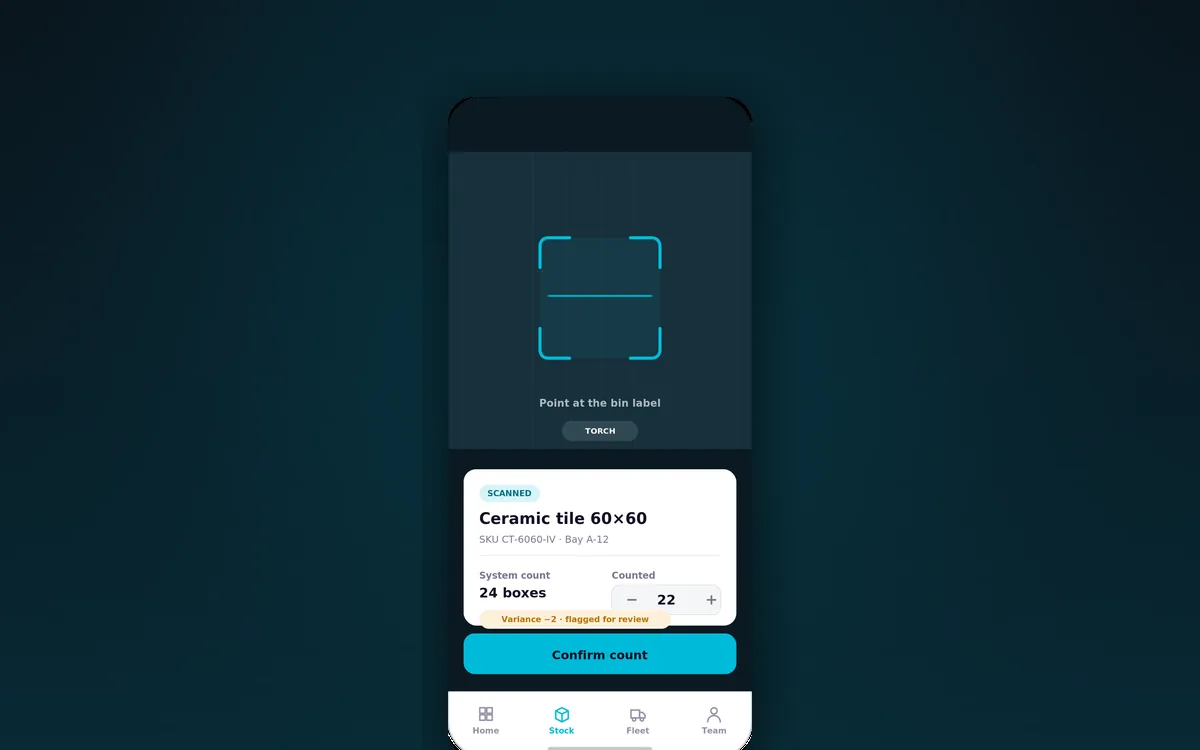
Stock counts by QR scan
Scan the bin label, confirm the count, and a variance is flagged for review instead of quietly corrupting your numbers. Works offline and syncs when signal returns.
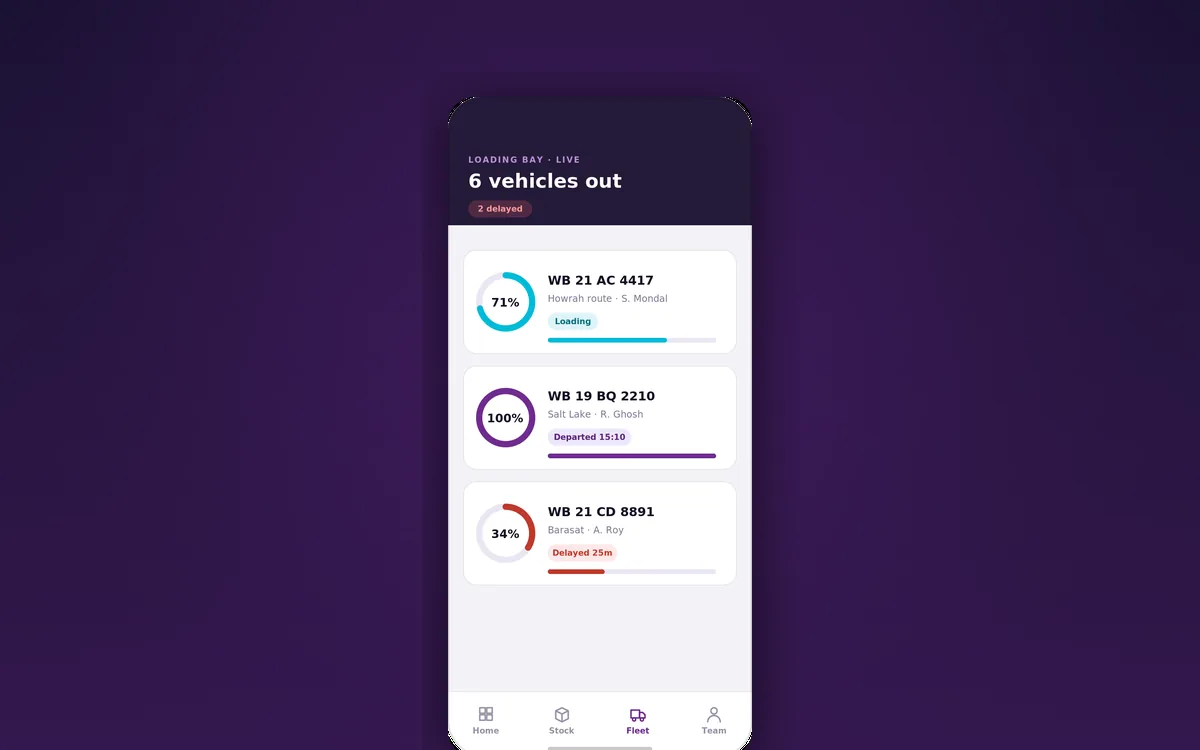
Loading status, live
Every vehicle with its route, driver, load progress and delay status. Dispatch stops phoning the bay to ask how far along they are.
The same engine, fitted to your situation
This is not a product you buy off a shelf and bend yourself around. The core is proven; what sits on top is configured for the sector, the workflow and the words your people already use.
Wholesalers and distributors
Salesmen raise orders on the road; the warehouse sees them as pick lists within seconds; loading and despatch close the loop. This is the two-app configuration we build most often.
Multi-branch retail
Stock across every branch on one ledger, with transfers, reorder points and per-branch performance visible to head office without a nightly export.
Shop floor and stores
Raw material consumption, work-in-progress and finished goods, tied to attendance and shift data so cost per unit is a number rather than a guess.
Field service businesses
Swap vehicle loading for job scheduling and van stock. Engineers see their day, consume parts against a job, and the office sees it immediately.
Restaurant and kitchen groups
Ingredient stock, wastage, supplier orders and staff rosters across several outlets, with the same manager dashboard.
From one depot to twenty
Start with stock and staff at a single site, add branches, vehicles and customers as you grow. The data model was built multi-site from day one.
What comes as standard
Staff and roles
Attendance, shifts and granular permissions, so a manager sees their branch and an admin sees everything.
Inventory
Multi-location stock with bins, batches, reorder points and full movement history.
QR and barcode
Scan to count, scan to pick, scan to load. Any Android phone works; rugged scanners if you have them.
Customers
Accounts, credit limits, order history and outstanding balances, visible to the salesman on the road.
Orders
Raised in the field or the office, routed to the warehouse as a pick list within seconds.
Vehicle loading
Load sheets per vehicle with live progress, delay flags and driver assignment.
Label printing
Bin, pick and despatch labels to Zebra or any network printer, straight from the phone.
Approvals
Discounts, credit extensions and write-offs routed for approval with a full audit trail.
Offline first
Warehouses and rural routes lose signal. Work continues and syncs when it returns.
Reporting
Despatch, stock ageing, salesman performance and branch comparison, exportable to Tally or Excel.
Alerts
Low stock, overdue loads and unusual variances pushed to the person who can act on them.
Audit trail
Every count, movement and approval attributable to a person and a time.
Not a chatbot bolted on the side
We add models where they remove real work, and leave them out where a rule would do the job more cheaply and more predictably.
Demand forecasting and reorder points
Reorder levels set from actual movement, seasonality and lead times rather than a number someone typed in three years ago. The system proposes; a human still approves.
Variance and anomaly detection
A count that does not fit the pattern gets flagged the same day rather than surfacing at the annual stocktake. This is usually where the system pays for itself.
Load and route optimisation
Suggested load sequences and delivery ordering based on drop points, vehicle capacity and traffic patterns, so the last drop is not an hour out of the way.
Ask your operation a question
Plain-language queries over your own data — which customers slipped this quarter, which SKU is dying, which route is consistently late — without waiting on someone to write a report.
Mobile, web, or both — your call
Linked mobile apps
Typically two: one for field sales, one for warehouse and loading. They talk to each other, so an order becomes a pick list instantly.
Web back office
Admin and manager functions in a browser, because nobody wants to reconcile a month-end on a phone.
One app or several
Some clients want a single app that changes by role. Others want them separate so a driver never sees pricing. Both are supported.
Your infrastructure
Runs in our cloud or yours. On-premises where stock and customer data has to stay inside the building.
Hardware you already own
Standard Android phones for scanning; rugged devices and label printers supported where you have them.
Integration
Feeds Tally, existing accounting or an ERP rather than demanding you throw it out.
What does it cost?
We do not publish a price, because we have never quoted two of these the same. The number depends on how many roles you need, whether it runs on our infrastructure or yours, what it has to integrate with, and how much of it you want us to keep running afterwards.
Tell us what you are trying to fix and we will come back with a fixed written scope and a fixed number — usually within a week, and at no cost.
Bring us the process that keeps breaking.
The stock count that never reconciles, the orders that get lost between the road and the warehouse, the loading bay nobody can see into. That is the demo worth having.