Complaints stop disappearing into an office
A citizen photographs the problem and sends it in thirty seconds. The right official is notified immediately, not next Tuesday. Everyone — the citizen included — can see exactly where it stands.
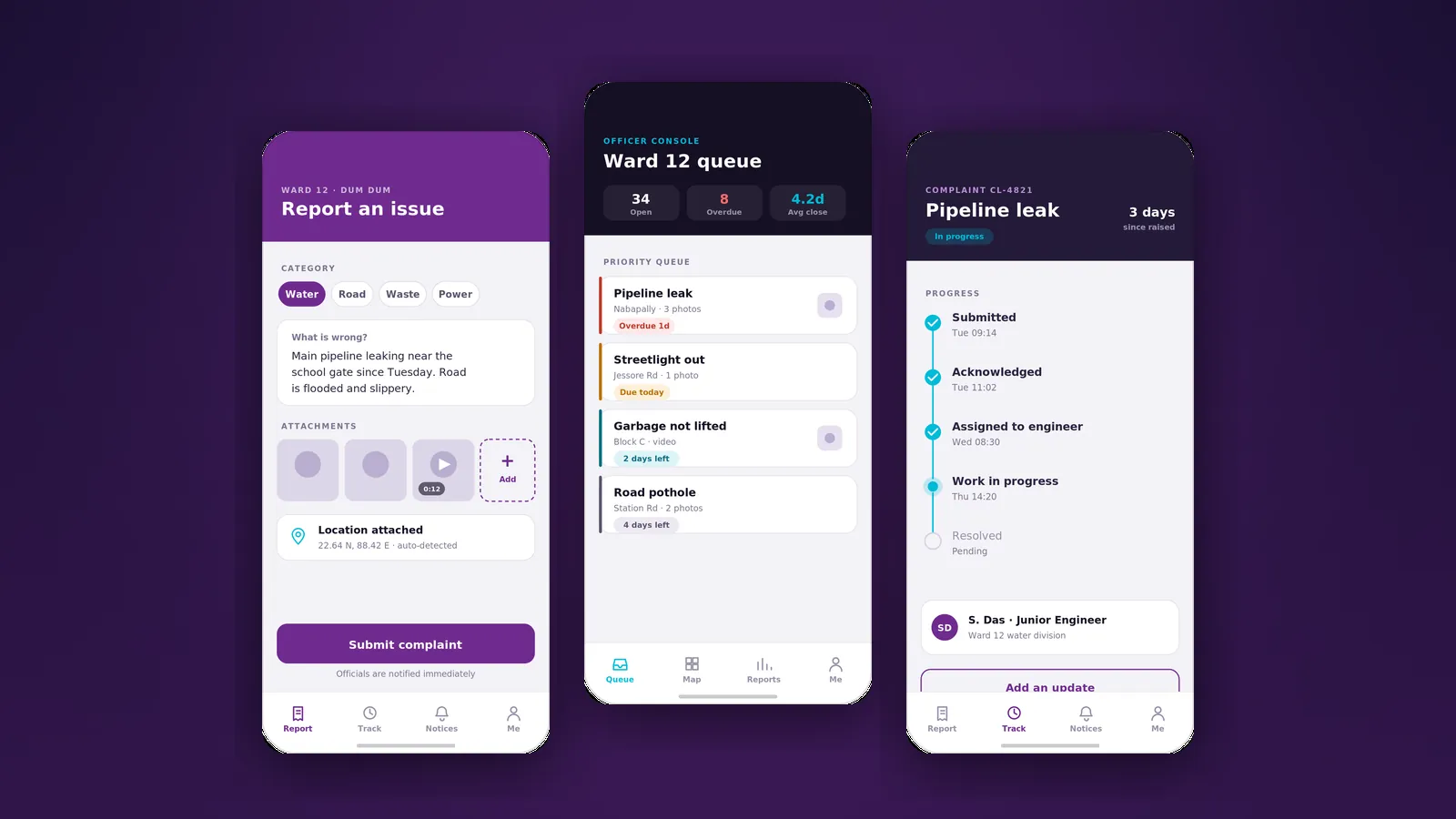
Most complaint systems fail for one reason: the person who reported the problem never finds out what happened. CivicLoop makes the status <em>public by default</em>.
What each person actually sees
Different people need different things from the same system. Each role gets a screen built for the job in front of them, not a cut-down version of someone else's.
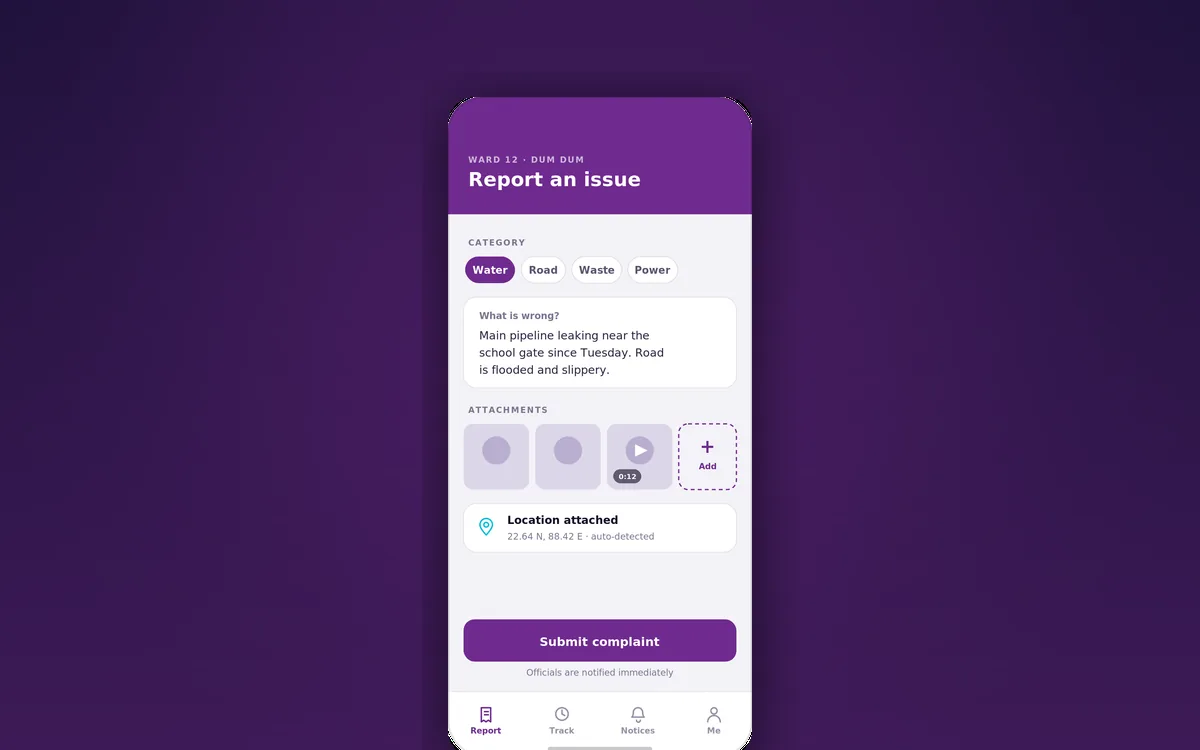
Report in under a minute
Pick a category, describe it, attach photos or video, and location is captured automatically. No account hunting, no form that times out, no office visit.
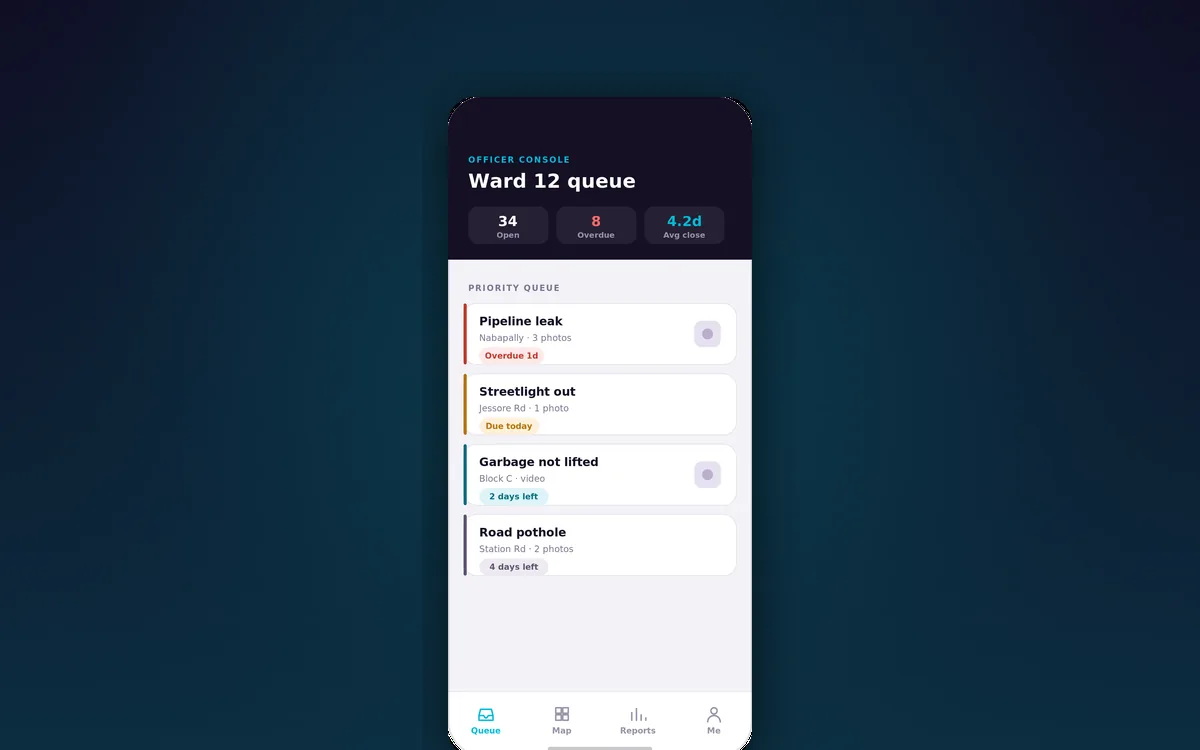
A queue that sorts itself
Complaints arrive as notifications and land in a priority queue with a live countdown against the response time you have committed to. Overdue items rise to the top on their own.
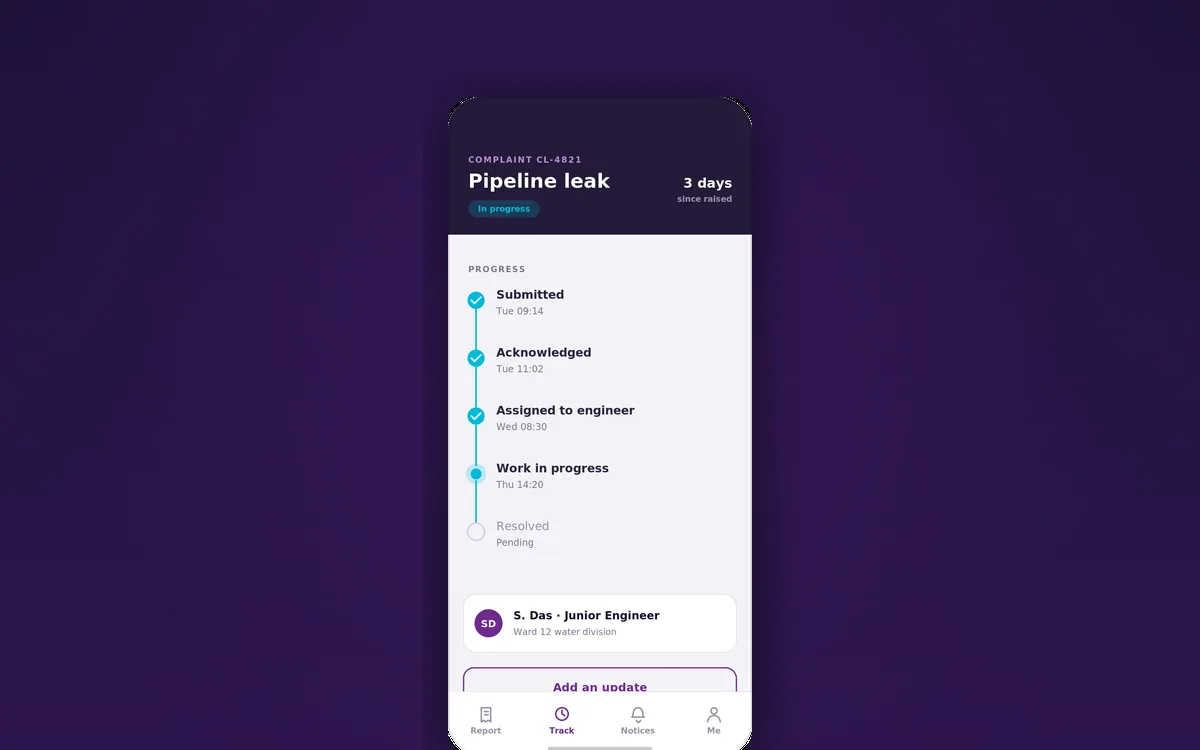
Status the public can see
Every step is timestamped and visible: submitted, acknowledged, assigned, in progress, resolved. The citizen can add photos mid-way if things change.
The same engine, fitted to your situation
This is not a product you buy off a shelf and bend yourself around. The core is proven; what sits on top is configured for the sector, the workflow and the words your people already use.
Ward and city corporations
Water, roads, waste, drainage, streetlights. Route by ward and department, with escalation when a response time is missed and reporting the council can put in front of the public.
Societies and gated communities
The same loop for maintenance complaints, with dues, notices, polls and visitor approvals added. Committees change every year — the record does not go with them.
Water, power and gas providers
Fault reporting with photographic evidence and location, feeding straight into the field team's job list rather than through a call centre.
Campuses, hospitals, large sites
Staff and visitors report faults from a phone; estates teams get a triaged queue with the SLA attached. Works equally well for a university or a factory.
Any organisation with a helpdesk
The same shape solves IT tickets, HR grievances and safety observations. Only the categories and routing rules change.
Where transparency is the point
Published dashboards showing volumes, response times and resolution rates by area. The strongest argument for adopting this is usually the one you can show voters.
What comes as standard
Rich evidence
Photos, video and voice notes attached at the point of reporting, with automatic location capture.
Instant notification
Push, SMS and email to the assigned official the moment a complaint lands.
Response-time tracking
Commit to a turnaround per category, then measure against it automatically.
Escalation
Unanswered items climb to the next level of authority on a schedule you set.
Assignment and handover
Route to a person, team or department; reassign without losing the history.
Public status
Citizens see progress without phoning anyone. This is the single biggest driver of trust.
Duplicate detection
Ten people reporting the same pothole become one job with ten followers.
Map view
Every open item plotted, so clusters and neglected areas become obvious.
Audit trail
Every action timestamped and attributable. Survives an inspection or an RTI request.
Notices and alerts
Broadcast outages, works and public notices back out to citizens in the same app.
Offline capable
Reports queue on the phone and send when signal returns.
Multilingual
Interface and categories in the languages your citizens actually use.
Not a chatbot bolted on the side
We add models where they remove real work, and leave them out where a rule would do the job more cheaply and more predictably.
Automatic categorisation and routing
The description and photo are enough to work out whether this is a water, roads or waste matter, and which department owns it. Officials stop triaging by hand, and misrouted complaints stop losing days.
Duplicate and cluster detection
Reports about the same problem are grouped by text and location similarity, so twenty complaints about one broken main become one job with twenty people to notify when it is fixed.
Photo assessment
Images are checked for what they actually show — severity, whether it is the reported category, whether it is a duplicate of an existing photo — and flagged for a human when the model is not confident.
Plain-language summaries
Long or rambling complaints are condensed into a one-line brief for the officer, in the language they work in, without losing the original text.
Mobile, web, or both — your call
Mobile apps
iOS and Android from one React Native codebase — one app for citizens, one for officials, or a single app that changes by role.
Web portal
The whole thing works in a browser too. Some clients want only the web version; some want both. Neither costs you a second build.
Public dashboard
An optional open page showing volumes and response times, which is often what wins the political argument internally.
Your infrastructure
Deployable in your own cloud or on-premises where citizen data cannot leave the jurisdiction.
Your branding
Your name, your colours, your domain. We are invisible unless you want us named.
Integration
Pushes into an existing ERP, GIS or ticketing system if one is already in place. We would rather feed your system than replace it.
What does it cost?
We do not publish a price, because we have never quoted two of these the same. The number depends on how many roles you need, whether it runs on our infrastructure or yours, what it has to integrate with, and how much of it you want us to keep running afterwards.
Tell us what you are trying to fix and we will come back with a fixed written scope and a fixed number — usually within a week, and at no cost.
Bring us your complaint backlog.
Show us how issues reach you today and where they get stuck. We will show you the same flow running in CivicLoop on a 20-minute call.